Reflections on the research and process for the illustrated story: La Limpia
By: Astrid Schwarz, St. John’s intern and creator of La Limpia children’s book
During my first few days as a summer intern for HSFF, the word “acequia” was thrown around the office at El Zaguán with surprising regularity. Each time, I would comb the conversation for context clues to guess what it meant. I had never heard of it before, despite having lived in Santa Fe for four years. Though the sign above the acequia in the garden at El Zaguán gave me a general idea, the frequency with which it was mentioned in conversations suggested that there was something more important about acequias than their mere practicality as agricultural tools. When I want to understand something, I always start with the etymology of the word to return to the clunky, worldly meaning that it originally had, from a time when you could hear the laboring hands behind each utterance. Acequia, I read, from the Arabic al saqiya, means “that which carries water.” It is a system of canals that carries water from rivers into fields to irrigate them, an ancient practice that dug its way across dry climates from Syria, Iran, Yemen, and Egypt into the Iberian Peninsula, and to the drylands of New Mexico during its Spanish colonization in the 16th and 17th centuries, merging with indigenous irrigation practices already in practice. Hooked by its history, the acequia became the focus of my research during my internship and led to the creation of a children’s story depicting with watercolor and ink the culture around acequias during the annual limpia, or spring cleaning, of the main ditch.
The idea began forming on a hot morning in early July. Feeling nervous about selecting a topic for my final project, which my supervisor had suggested I could illustrate, I stepped under the heavy arched doorway in the corner of the Brooks House. The archives room always had a clay-like, stale smell which I rather liked. After turning on the creaky fan to air out the room, I pulled out a file titled ACEQUIAS GENERAL, still only vaguely understanding what the word meant. The necessity for irrigation ditches in such an arid climate as New Mexico did not surprise me. But what caught my attention were two points of research: the shared practice between the Middle East and New Mexico, and the degree of significance that acequias had in the formation of “water democracies” during early New Mexican settlement. I learned that water policy formed the basis of social institutions for Spanish settlers, securing both basic needs and a society built around mutual responsibility.
As I ruminated over my reading, I thought of the first page of Nathanial Hawthorne’s The Scarlet Letter. Set in humid, Puritan New England, Hawthorne suggests that the first structures built by settlers were a cemetery, a prison, and, later, a church. By analogy, the most fundamental structures built by
Spanish settlers in the dry and scarce southwest were acequias.
While this may not be strictly true, Spanish settlers were required under settlement policies entitled The Laws of the Indies of 1680 to choose land near water sources that could be irrigated, and tested the soil for its capacity to hold water before establishing communities. Acequias were essentially the first public labor projects, often preceding churches, and gave these groups an internally-directed political structure around the formation, management, and maintenance of acequias. Hawthorne’s fictional world was founded on harsh penalties and religion; the New Mexican settler world was founded on water sharing and collaboration. However, not entirely unlike Hawthorne’s emphasis on discipline, acequias also carried the strict rule of law with them. It came with the election of a water chief, the mayordomo, to mediate conflicts, oversee work, and uphold the institution of fines for transgressions. In times of scarcity, the contract was accompanied by the watchful eye of the neighbor ensuring his crops get no less water than yours, and that you are punished if that is not the case.
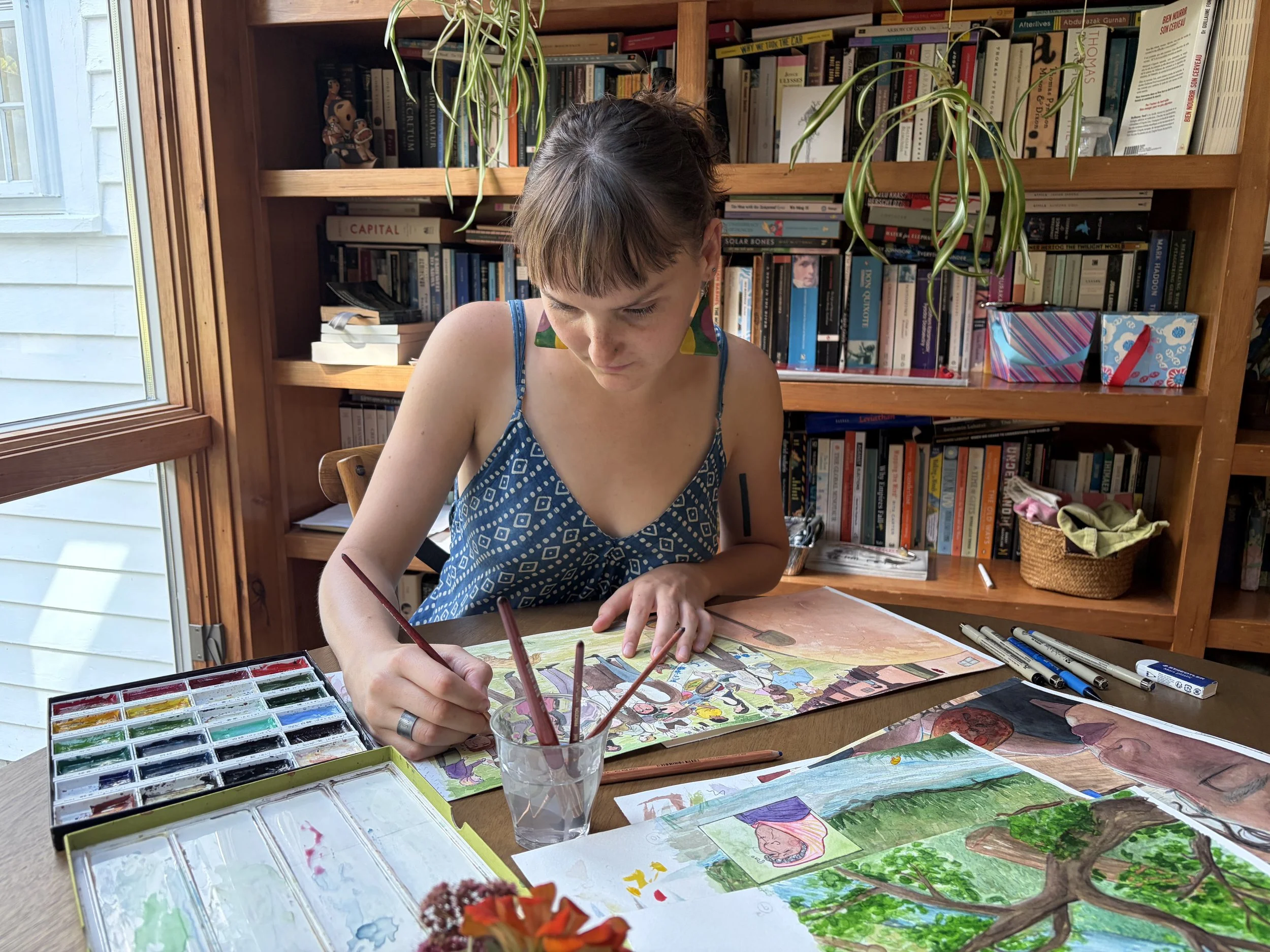
I went off to eat my lunch on the shady porch of El Zaguán’s garden, mulling over the word saqiya. Hours of reading with the creaky fan behind me had formed a list of all that is carried by the acequia, both directly and indirectly. That which carries water… carries every meal eaten by the families along the ditch, carries the ease and hard work of a good harvest, carries security, political, social, and economic relations, class distinctions, and stories of countless generations passing down the responsibility of maintaining the ditch system. But how do I make a children’s book that encompasses all of this? Well, I thought, what if we went really simple.
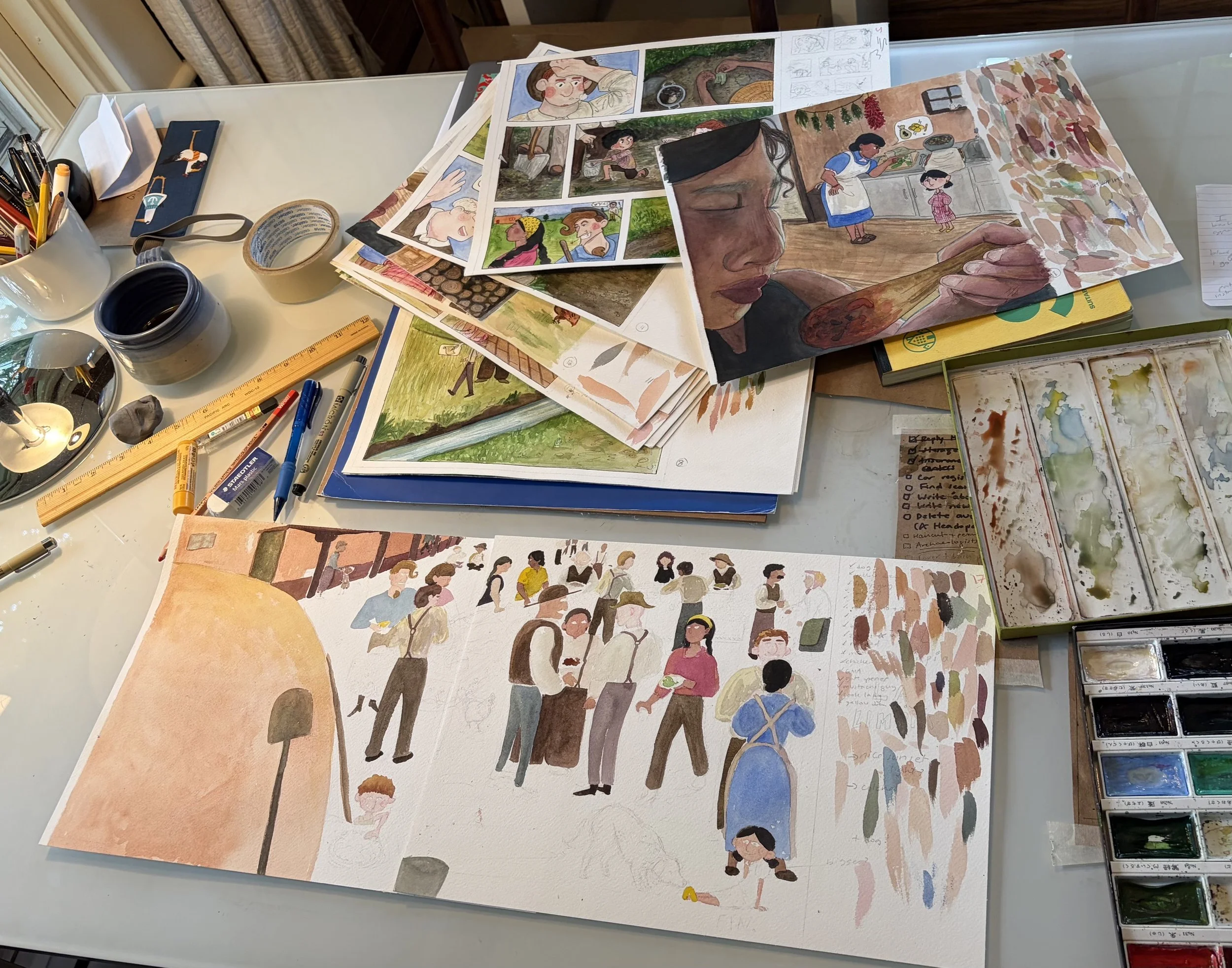
That which carries water could certainly carry a small shoe… a yellow shoe floating along the ditch. Suddenly, around that image appeared a community of parciantes, owners of land along the main ditch, with various relationships: a slow-working teenager chided by the mayordomo makes the first page of the story, followed by an attempted flirtation among the clanking of shovels, a farmer accusing his neighbor of not respecting water allocation agreements as the yellow shoe drifts past in the foreground, and finally, steaming fresh plates being set on a table to feed a line of tired workers at the end of the day.
Later in the month, in the second archival room, I came across a crinkly little folder of photos relating to acequias. One image from the 1940s caught my eye, showing a little girl watching a farmer direct water towards his crops. She wore a plaid dress with a collar, and became the main character of my story and the owner of the little yellow shoe. While details of the origins of acequias did not make it into my story, all of my research played a part in painting a picture of the culture of acequia communities and what they carry when they maintain this longstanding tradition (besides a shoe). Along with the
vivid descriptions in Stephen Crawford’s fictionalized memoir Mayordomo, Sylvia Rodriguez’s research helped me understand the necessity for acequias to remain functional today, as centers of self-governance and collaboration, and support of local ecology.
I loved getting deep into the research around acequias and their role in historic preservation, and also had a lot of fun researching all the little details to help my paintings be accurate within the narrative, like looking up period-accurate sheep breeds and shoe styles, horno oven designs, cottonwood branch shapes, and native New Mexican birds. I sincerely want to thank Giulia Caporuscio for her support and feedback throughout the whole process, as well as Story, Melanie, Jacob, and Ann for their kindness during my time at El Zaguán.
La Limpia is available to purchase in the El Zaguán gift shop.
Further reading:
1. David Snow, “The Santa Fe Acequia Systems: Summary Report on Their History and Present Status, with Recommendations for Use or Protection” (report prepared for the City of Santa Fe Planning Department, 1988).
2. Steven Crawford, Mayordomo (Albuquerque: University of New Mexico Press, 1993).
3. Sylvia Rodriguez, “Acequia History, Culture, and Ecology” (talk, HSFF Salon, Brooks House, January 20, 2026), Youtube video, 1:03:41 https://www.youtube.com/watch?v=tjys0NOwKcE.
4. Jose A. Rivera and Thomas F. Glick, “Iberian Origins of New Mexico’s Community Acequias” (University of New Mexico Digital Repository, 2025), https://digitalrepository.unm.edu/cgi/viewcontent.cgi?article=1020&context=arch_fsp.